Why some suppliers flourish – and others quietly fail
Every contract manager eventually realises a difficult truth.
Performance problems are rarely just about process.
They are about people, incentives and capacity.
Two suppliers can hold identical contracts, operate under the same KPIs and receive the same oversight – yet deliver entirely different outcomes. The difference usually sits at the intersection of two variables:
Commitment – their willingness to engage, collaborate and invest in the relationship.
Capability – their operational ability to deliver consistently and competently.
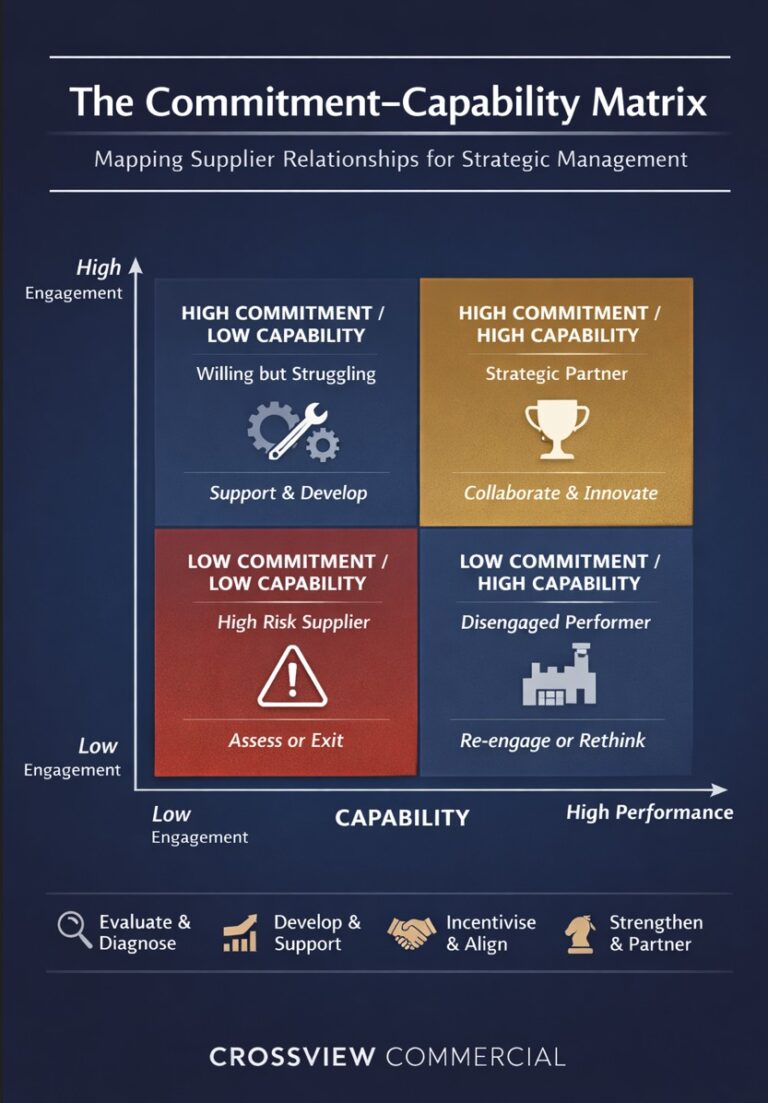
When you plot suppliers against these two dimensions, a powerful pattern emerges. The Commitment–Capability Matrix becomes less of a theoretical model and more of a diagnostic lens.
It forces clarity.
Quadrant One: Low Commitment / Low Capability
This is the most fragile position.
The supplier struggles operationally and demonstrates limited interest in improvement. Meetings feel transactional. Delivery is reactive. Improvement plans lack urgency.
In this quadrant, the question is not “how do we motivate them?” but “is this relationship viable?”
If the service is strategically critical and switching costs are high, you may attempt a short, tightly governed recovery plan with explicit milestones and consequences. However, this must be time-bound and evidence-led. Prolonged tolerance of low commitment and low capability drains internal resource and erodes credibility.
Commercial discipline matters here. Either capability improves quickly or dependency must reduce.
Quadrant Two: High Commitment / Low Capability
This is the supplier who wants to succeed but lacks sufficient infrastructure, expertise or resilience.
Conversations are constructive. Intent is clear. Delivery is inconsistent.
This is often where intelligent contract management adds the most value. Because commitment exists, development is possible. Structured improvement plans, targeted support, process redesign or clearer KPI definitions can significantly raise performance.
However, goodwill alone is not enough. Capability gaps must be measured and addressed systematically. The goal is not to protect effort; it is to build competence.
Handled correctly, suppliers in this quadrant can evolve into strong long-term partners. Mishandled, they remain perpetually “almost there”.
Quadrant Three: Low Commitment / High Capability
This is the technically strong but disengaged supplier.
They deliver — but without enthusiasm. They comply – but do not collaborate. Communication is minimal. Innovation is limited. The relationship feels distant.
Often the root cause lies in incentive misalignment. The contract may represent a small proportion of their portfolio. Margins may be tight. Leadership attention may sit elsewhere.
The commercial risk here is subtle. While capability is present, lack of commitment reduces resilience. When pressure increases – staffing shortages, competing priorities, financial strain – your contract may slip down their list of concerns.
The response is strategic recalibration. Revisit incentives. Clarify mutual value. Increase senior engagement. If alignment cannot be restored, consider diversification to reduce dependency.
High capability without commitment is stable – until it is not.
Quadrant Four: High Commitment / High Capability
This is where trust becomes a commercial asset.
Delivery is consistent. Governance is proactive. Issues are raised early rather than concealed. Continuous improvement is visible.
These suppliers should not be managed solely through compliance mechanisms. They should be engaged strategically. Joint problem-solving, information sharing and forward planning strengthen resilience on both sides.
However, even strong partnerships require structure. Over-familiarity can dilute accountability. The matrix is dynamic – suppliers can move between quadrants if oversight weakens.
Sustained high commitment and capability require deliberate stewardship.
Why the Matrix Matters
The real power of the Commitment–Capability Matrix lies in differentiation.
Not all suppliers require the same management style.
Some need challenge.
Some need development.
Some need incentive realignment.
Some need strategic partnership.
Without a clear framework, organisations either overmanage high performers or under-challenge underperformers. Both waste resource.
Mapping suppliers regularly against commitment and capability allows you to:
- Prioritise contract management effort proportionately
- Target support where it delivers return
- Identify structural risk early
- Reduce overreliance on fragile relationships
- Build a balanced supplier portfolio
Over time, consistent delivery combined with openness builds trust. And trust, in commercial environments, reduces friction, accelerates resolution and strengthens resilience under pressure.
But trust must be earned through evidence, not assumed through familiarity.
The Crossview Commercial Approach
At Crossview Commercial, we use the Commitment–Capability Matrix as part of a broader supplier performance architecture.
We help organisations:
- Assess supplier positioning objectively
- Diagnose whether issues are behavioural, structural or incentive-driven
- Design targeted improvement interventions
- Reset governance where necessary
- Develop high-performing suppliers into strategic partners
Supplier management is not about treating every contract identically. It is about applying the right commercial strategy to the right behavioural profile.
Because strong contracts do not happen by chance.
They are designed, differentiated and deliberately led.