Why fixing the symptom is not the same as fixing the problem
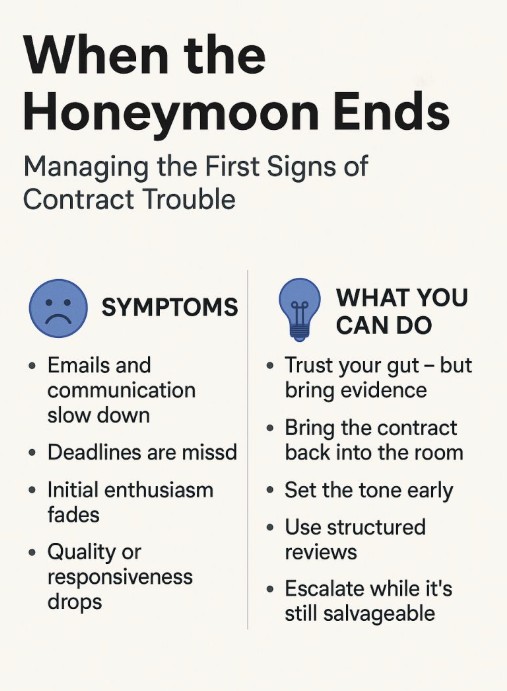
When a contract begins to underperform, the pressure builds quickly.
KPIs turn amber, then red.
Stakeholders ask what is being done.
Senior leaders want reassurance.
The instinctive response is to act. Draft a remedial action plan. Schedule additional meetings. Add oversight. Increase reporting frequency.
Movement feels like progress. But without Root Cause Analysis (RCA), movement is often just motion.
Too many remedial action plans focus on what will change, without first understanding why the issue emerged. Suppliers and contract managers alike can fall into the trap of solving what is visible rather than what is structural. The result is predictable: temporary improvement followed by recurrence.
RCA is not an academic exercise. It is commercial discipline.
Why Root Cause Analysis Matters
Root Cause Analysis forces clarity. It distinguishes between surface symptoms and underlying drivers.
A missed reporting deadline might look like poor time management. A spike in complaints might appear to be frontline staff error. A backlog might be framed as insufficient effort.
But dig deeper and the causes often sit elsewhere: unrealistic assumptions at mobilisation, unclear specification requirements, misaligned incentives, structural under-resourcing or inefficient process design.
RCA ensures three things:
- Recurrence is reduced. Addressing the true driver of the issue makes repetition less likely.
- Resources are used intelligently. There is little value in adding oversight or issuing warnings if the problem is capacity or design.
- Collaboration improves. When both parties engage in structured analysis rather than defensive posturing, the tone shifts from blame to problem-solving.
Skipping RCA may feel faster. In practice, it is more expensive.
A Practical Approach to RCA
Root Cause Analysis does not need to be complicated to be effective. It requires discipline, not bureaucracy.
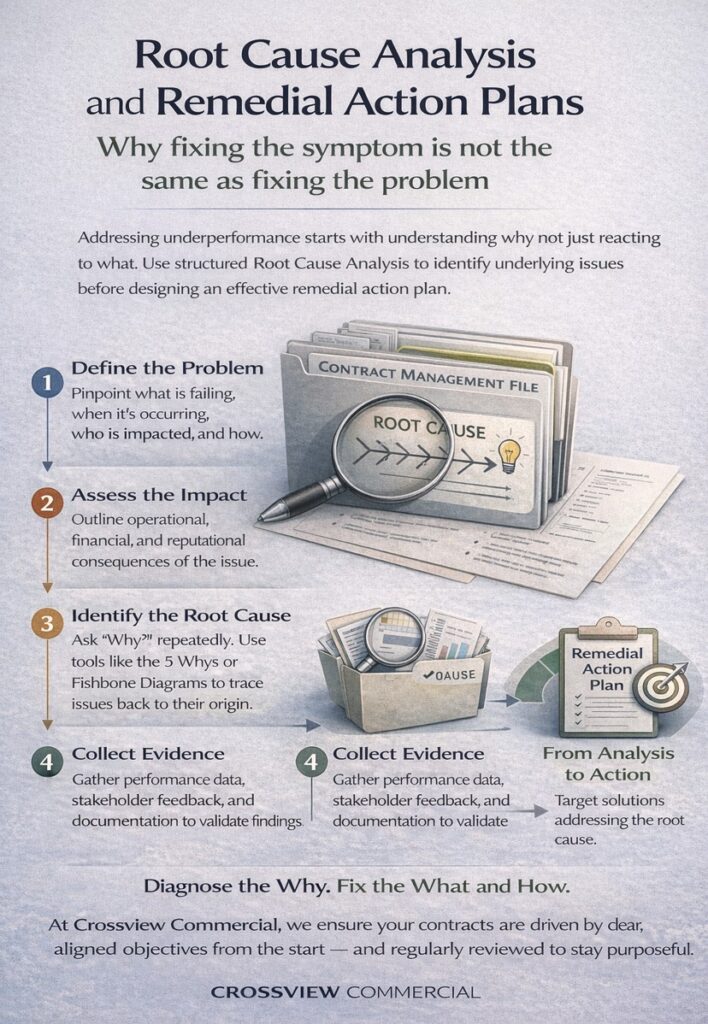
Start by defining the problem precisely. What is underperforming? Is it a specific KPI, a deliverable, a timeline or a quality standard? When does it occur and who is impacted? Vague problem statements lead to vague solutions.
Next, assess impact. What are the operational consequences? Are decision-making timelines disrupted? Are costs increasing? Is reputational risk emerging? Understanding impact helps calibrate the seriousness of the response.
Then move to causation.
The 5 Whys technique remains one of the simplest and most powerful tools. Ask why repeatedly until the answer stops changing. Alternatively, use a Fishbone (Ishikawa) framework to explore potential drivers across categories such as people, process, systems, governance and environment.
Crucially, consider both internal and external factors. Underperformance is rarely one-sided.
Finally, gather evidence. Performance data, communications, workload analysis, comparative benchmarks and stakeholder feedback all help prevent subjective interpretation. Evidence grounds the discussion.
An Example in Practice
Take a relatively common issue: reports arriving 10 to 15 days late.
The visible problem is delay. The operational impact may include disrupted decision-making, increased staff workload and reduced confidence in supplier reliability.
But the cause?
Perhaps the supplier’s review process is elongated. Why? Because their reporting team is under-resourced. Why? Because budget reductions led to staffing cuts. Beneath that, there may also be complexity in the reporting template or unclear timeline expectations at contract award.
The root cause might ultimately be inadequate resourcing combined with overly complex reporting requirements. Without that diagnosis, a remedial plan might simply demand punctuality – a solution disconnected from the constraint.
Collaboration Is Not Optional
Effective RCA cannot be conducted in isolation. Suppliers hold operational insight. They understand workflow bottlenecks, staffing realities and internal pressures. Contract managers hold performance oversight, comparative data and broader organisational context.
When RCA is conducted jointly, accountability increases. Defensiveness reduces. Solutions become practical rather than aspirational. It also shifts the tone of the remedial plan itself.
Instead of punitive escalation, the focus becomes targeted intervention.
From Analysis to Action
Root Cause Analysis is not the end. It informs the remedial action plan.
Objectives should directly address the identified root cause. If the issue is resourcing, the plan may include workforce adjustments or timeline recalibration. If the issue is unclear specification, the solution may involve redefining deliverables or simplifying reporting structures.
Implementation steps must be measurable and time-bound. Monitoring should test sustainability, not just short-term correction. The goal is not simply to return a KPI to green for one quarter. It is to stabilise performance structurally.
The Crossview Perspective
At Crossview Commercial, Root Cause Analysis is a non-negotiable stage of any performance recovery process.
We integrate RCA into our broader Alignment Model to ensure that remedial actions address structural misalignment rather than surface indicators. Our approach combines data analysis, structured stakeholder interviews and behavioural insight to diagnose accurately before prescribing change.
Because issuing a remedial action plan without diagnosis is not decisive.
It is reactive.
Taking the time to understand “why” ensures that the “what” and the “how” actually work.
And in contract management, sustainable improvement is always worth the discipline.