Most organisations agree on one thing.
Reactive contract management is exhausting.
The inbox becomes a queue of urgent issues. A missed compliance milestone here. A delayed invoice there. A performance query that escalates before anyone has fully understood it. The contract manager becomes a firefighter, moving from one small blaze to the next. It feels busy. It feels necessary. It rarely feels strategic.
And yet, the difference between reactive and proactive contract management is not theoretical. It is structural.
What Reactive Contract Management Really Looks Like
Reactive contract management is characterised by response rather than anticipation.
Issues are addressed once they surface visibly. Root causes are rarely analysed because the immediate priority is containment. Governance becomes event-driven. Performance discussions focus on what went wrong last month rather than what might go wrong next quarter.
This mode is not usually a choice. It is a by-product of:
- Unclear roles and responsibilities
- Fragmented processes
- Limited data visibility
- Under-resourced teams
- Over-reliance on informal communication
In this environment, even capable contract managers struggle to get ahead. The system itself pulls them into reaction. The result is predictable: recurring issues, preventable escalations and limited strategic impact.
What Proactive Contract Management Requires
Proactive contract management is not simply about working harder. It is about designing differently.
In a proactive model, contract managers are not waiting for problems to crystallise. They are monitoring early indicators, reviewing structural risks and engaging stakeholders before pressure builds. They move from operational responders to strategic partners.
This shift requires more than intent. It requires infrastructure.
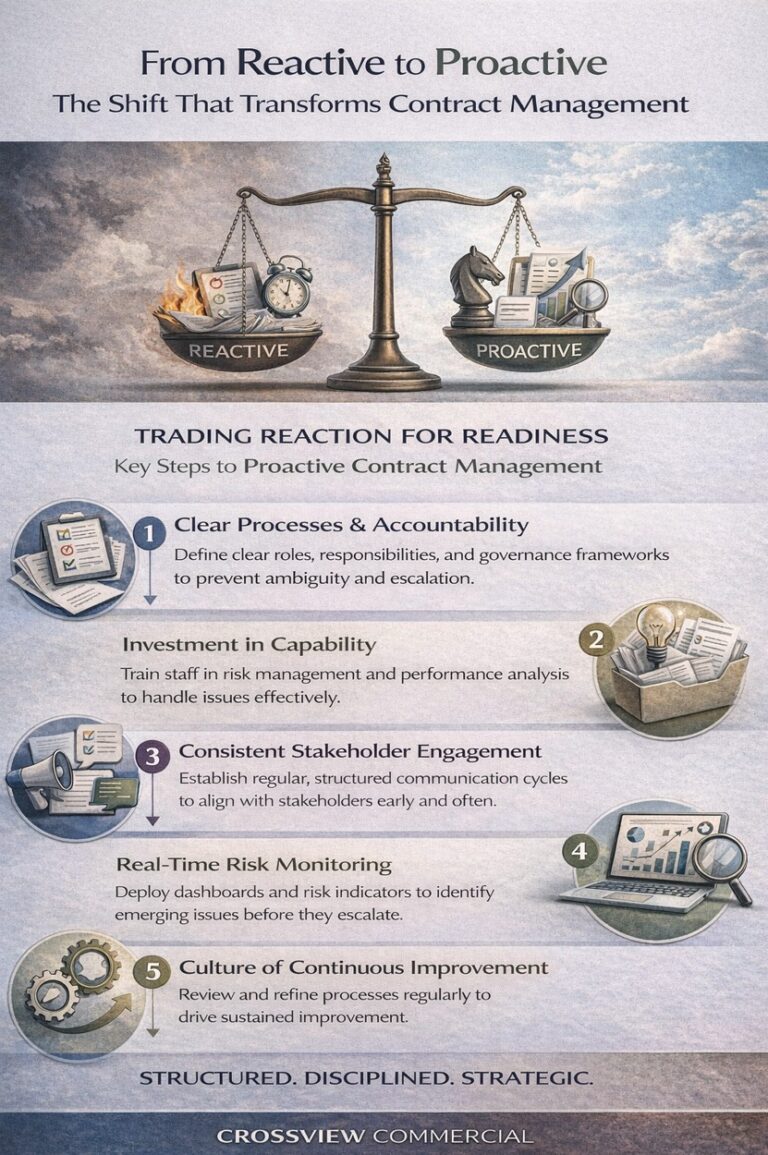
1. Clear Processes and Defined Accountability
Proactivity begins with clarity.
Every contract should have documented governance structures, escalation routes and ownership boundaries. When responsibilities are ambiguous, delays and duplication follow. When they are explicit, accountability strengthens.
A well-structured Contract Management File becomes central here. It anchors objectives, reporting cadence, risk thresholds and review points. Without this foundation, proactivity is aspirational rather than operational.
2. Investment in Capability
Even the strongest process framework fails if the team lacks confidence or skill.
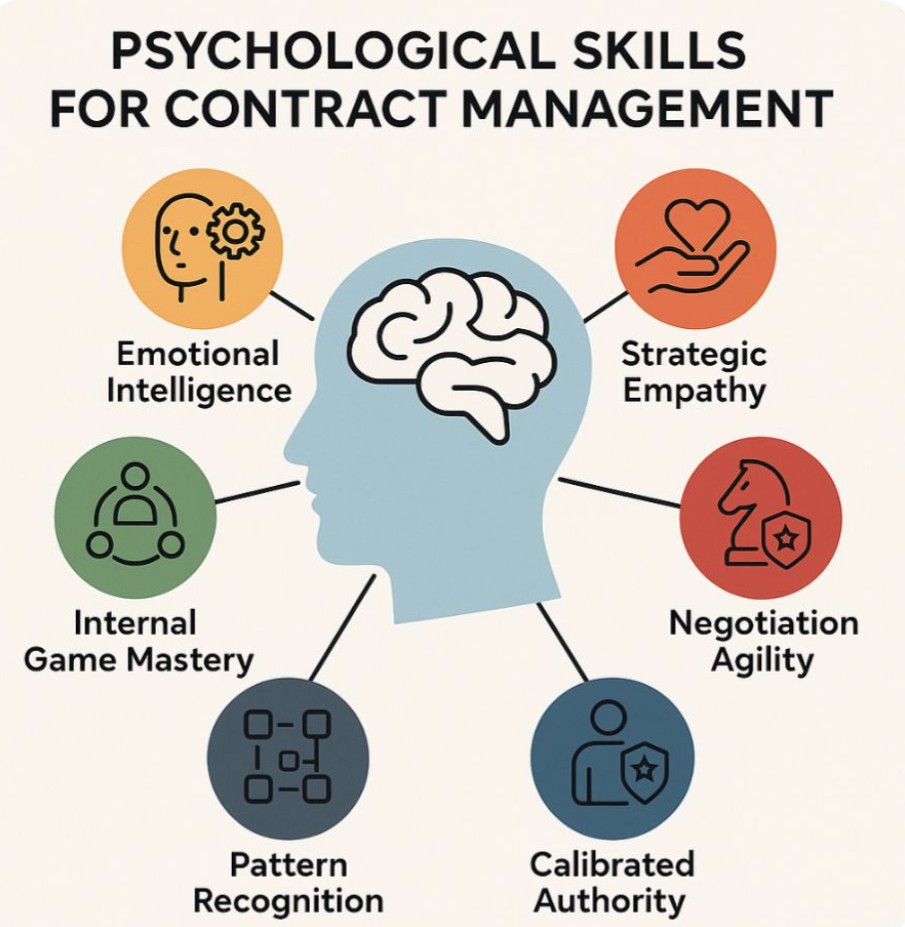
Proactive contract management requires behavioural competence as much as technical knowledge. Teams must understand how to interpret risk indicators, conduct structured performance conversations and apply root cause analysis before issues escalate.
Workshops, scenario simulations and continuous learning are not luxuries. They are enablers of strategic maturity.
Empowered contract managers do not simply monitor KPIs. They interpret them.
3. Consistent Stakeholder Engagement
Proactivity thrives on communication rhythm. Regular check-ins with stakeholders – both internal and supplier-side – create visibility. They surface emerging pressures early. They maintain alignment on objectives and expectations.
Silence, by contrast, creates false reassurance.
Structured communication does not need to be heavy. It needs to be predictable. Predictability builds trust and reduces surprises.
4. Real-Time Risk Visibility
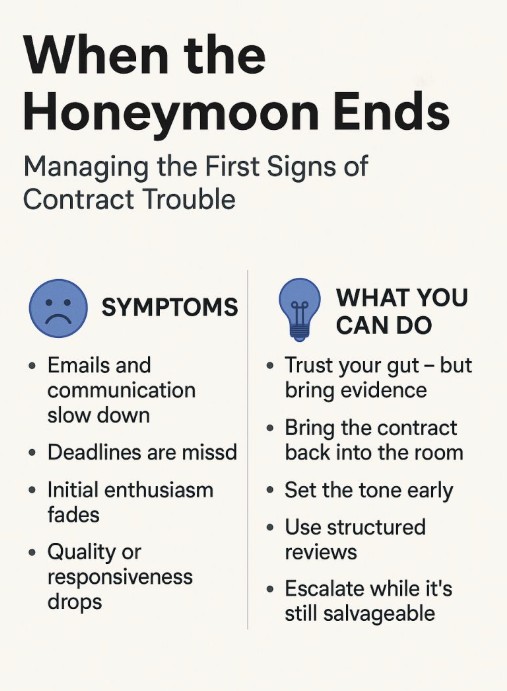
Proactive contract management relies on data transparency. Dashboards, risk registers and performance trend analysis tools allow early pattern recognition. A gradual increase in response times. A subtle decline in quality metrics. A shift in cost variance.
These are rarely sudden failures. They are signals.
Tools such as Power BI or structured Excel dashboards are not about aesthetics. They are about foresight. When information is visible, action can be timely rather than reactive.
5. A Culture of Continuous Improvement
Perhaps the most important element is mindset. Each issue should generate learning. Each review cycle should refine process. Each annual contract discussion should test alignment against current organisational priorities.
Continuous improvement turns individual corrective actions into systemic enhancement.
Over time, the function evolves from firefighting to forecasting.
The Real Difference
Reactive contract management asks, “What went wrong?”
Proactive contract management asks, “What could go wrong – and how do we prevent it?”
The difference is subtle but transformative.
One consumes energy. The other creates control.
Organisations that invest in structured processes, capability building and early risk visibility consistently outperform those operating in reactive mode.
Not because they avoid problems entirely.
But because they see them earlier – and respond deliberately rather than defensively.
The Crossview Perspective
At Crossview Commercial, we help organisations redesign their contract management functions to move from reactive oversight to proactive performance leadership.
Our approach focuses on:
- Governance clarity
- Role and accountability mapping
- Performance dashboard design
- Risk architecture development
- Behavioural capability strengthening
Because proactivity is not a personality trait. It is a system design choice.
And when that system is structured well, contract management becomes not a burden – but a strategic advantage.