Because numbers do not just show cost. They reveal thinking.
At tender stage, price is often reduced to a single figure.
One total. One line. One comparison point.
It looks efficient. It looks tidy. It looks easy to score. It is also dangerously incomplete.
A contract budget is not merely a financial proposal. It is a window into how a bidder understands the service, how they plan to deliver it and how they manage risk. That is why requesting a full budget breakdown – ideally with room for bidders to present their own structure rather than simply filling in a rigid template – is commercially invaluable.
Transparency Is Not Cosmetic
A detailed breakdown demonstrates how the bidder arrived at their total.
It reveals assumptions.
It exposes allocation logic.
It shows where cost concentration sits.
Without this visibility, evaluators assess outcomes without understanding inputs. With it, you can test credibility.
Are staffing costs proportionate to the service model described?
Is management overhead realistic?
Have indirect costs been considered?
Is there appropriate contingency?
Transparency reduces guesswork and strengthens due diligence.
It Tests Understanding of Scope
A granular budget is often the quickest way to see whether a bidder truly understands the contract.
Have they factored in mobilisation?
Training?
Quality assurance?
Data reporting?
Governance meetings?
When costs appear overly simplified or key elements are absent, it often signals superficial analysis of the specification. Conversely, a carefully structured breakdown reflects attention to detail and genuine engagement with the scope of work. Budgets expose comprehension.
It Reveals Risk Before Award
Perhaps the most important value of a detailed breakdown lies in risk identification.
Underestimation of staffing.
Absence of contingency.
Overreliance on optimistic productivity assumptions.
Unfunded dependency on external factors.
Tight margins that leave no resilience.
These risks do not disappear after contract award. They materialise as performance issues, requests for variation or financial instability.
At tender stage, you have the rare opportunity to see those signals early. This is where commercial judgement becomes predictive rather than reactive. Predicting the future at this stage is not mysticism. It is pattern recognition.
Why Flexibility in Format Matters
Many organisations require bidders to complete a standard pricing template. Templates provide comparability and control. They are useful.
But allowing some flexibility in presentation can offer deeper insight.
When bidders are permitted to structure their breakdown more openly, you see their budgeting maturity. You see how they categorise costs. Whether they plan across the lifecycle or focus narrowly on year one. Whether they consider inflation, risk mitigation or scenario variation.
Some will include phased options. Others will outline cost sensitivity or efficiency improvements. The stronger bidders will explain assumptions clearly rather than hiding them in small print. Format flexibility reveals business acumen.
It Demonstrates Commercial Capability
A thoughtful breakdown shows long-term planning, risk management discipline and understanding of contract duration.
It may show:
- Lifecycle costing
- Inflation modelling
- Resource ramp-up or tapering
- Scenario-based pricing
- Clear separation between fixed and variable costs
These are not cosmetic enhancements. They indicate whether the supplier understands commercial sustainability.
Suppliers who demonstrate adaptability and willingness to tailor options signal maturity. They are not merely selling a number. They are offering a structured solution.
Value Is Not Always the Lowest Figure
A total price without context can be misleading.
A lower bid with fragile assumptions is rarely good value. A higher bid with transparent cost drivers and contingency planning may represent lower long-term risk. Value sits at the intersection of cost, credibility and resilience.
The evaluator’s role is not to accept numbers at face value but to interpret them intelligently.
The Real Skill: Seeing Behind the Numbers
Every detail in a budget tells a story.
- Where resources are concentrated.
- Where risk is under-acknowledged.
- Where assumptions are optimistic.
- Where contingency is absent.
Numbers can appear neutral. They are not. They reflect decisions, trade-offs and judgement.
Requesting a full breakdown does more than improve financial transparency. It strengthens commercial foresight. Because the true skill in contract management is not reading numbers.
It is understanding what they imply about the future performance of the contract.
And the earlier you see that future, the more control you retain.
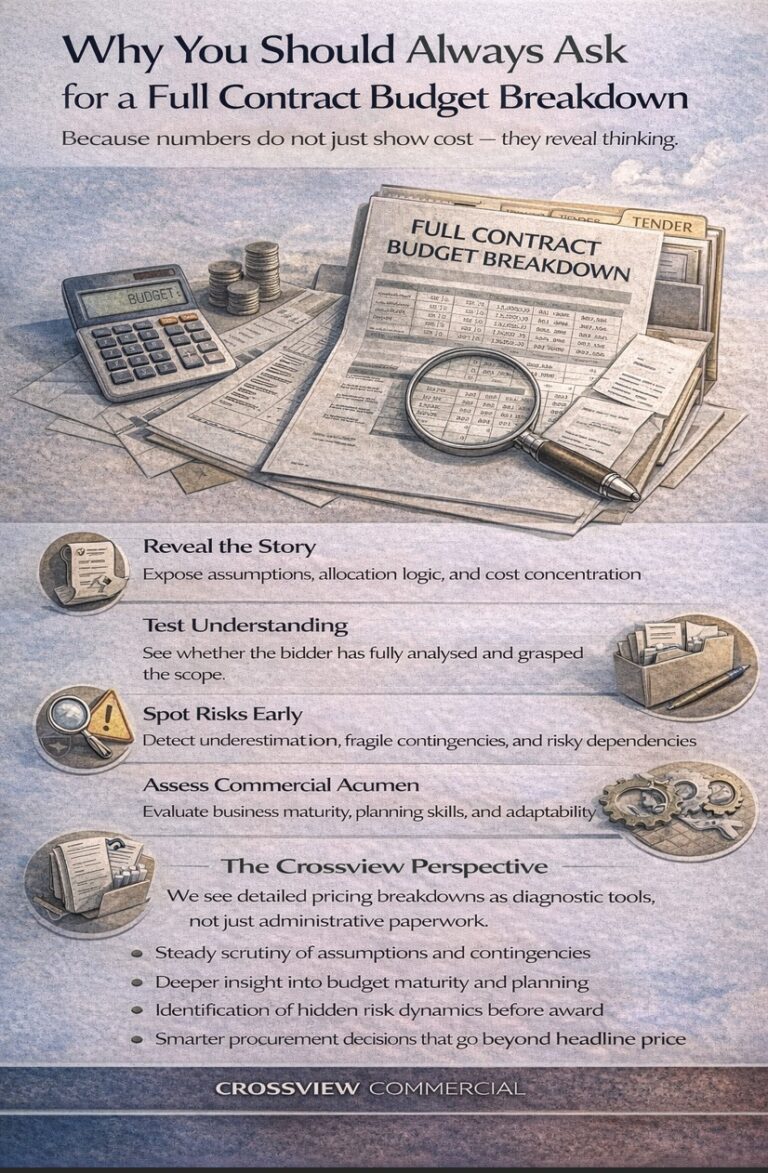
The Crossview Perspective
At Crossview Commercial, we view pricing schedules as diagnostic tools, not administrative attachments.
When we support organisations through tender evaluation, we do not stop at comparing totals. We interrogate structure. We test assumptions. We assess sustainability. We look for alignment between the narrative method statement and the financial model that underpins it.
Our approach includes:
- Structured budget scrutiny against service model and workforce assumptions
- Identification of underestimation and hidden risk exposure
- Testing contingency and lifecycle costing logic
- Assessing commercial resilience beyond year one
- Advising on clarification questions that surface risk before award
We believe the strongest procurement decisions are made not by selecting the lowest compliant price, but by selecting the most commercially sustainable proposal.
Because a contract rarely fails due to what was written in the specification. It fails when the numbers never truly supported the promise.
Crossview Commercial helps you see that difference – before you sign.