Because belief is not assessment.
In contract and service management, change is not an event. It is a constant.
A supplier proposes a variation to reflect market pressures. A budget challenge requires cost reduction. A commissioner adjusts eligibility criteria. A delivery team redesigns a pathway to improve flow. A policy shift alters expectations mid-cycle.
On paper, each of these changes may look rational. Sensible. Necessary.
And in our heads, we often feel we understand the impact.
“It will only affect a small cohort.”
“It’s just a minor budget adjustment.”
“The quality risk is manageable.”
But belief is not assessment.
And that distinction matters more than most organisations realise.
The Moment Before the Decision
There is always a moment before a decision is signed off.
A meeting where the financial saving looks attractive. A conversation where operational logic feels clear. A slide deck that presents the change as tidy and controlled.
That moment is precisely when discipline is required.
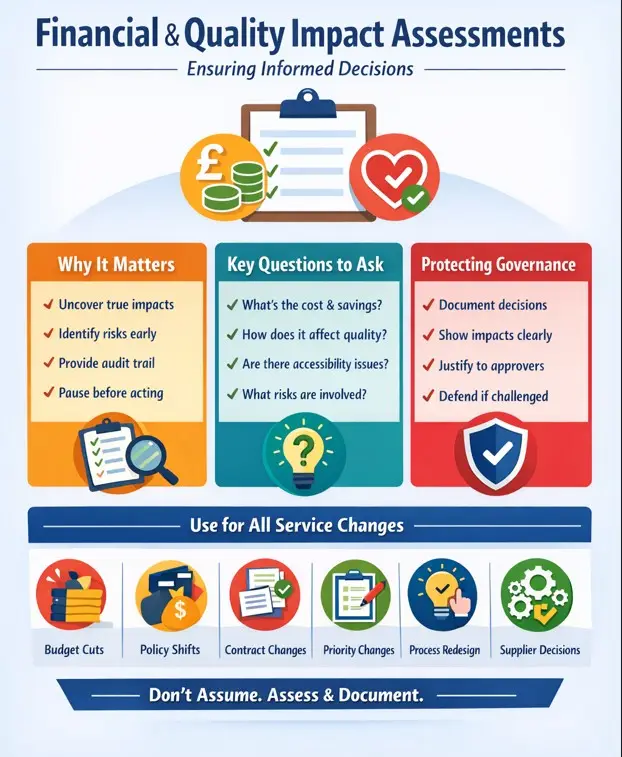
A Financial and Quality Impact Assessment forces a pause.
It interrupts assumption.
It slows momentum just enough to examine consequence.
It asks uncomfortable questions before implementation rather than after escalation.
The value does not sit in the form itself.
It sits in the act of completing it.
Writing something down changes thinking. Structured thinking reduces unintended harm.
What It Actually Tests
A structured assessment moves beyond surface logic and into system impact.
It asks:
- What is the full financial implication – initial cost, ongoing cost and projected savings?
- Is the saving real or simply a cost transfer elsewhere in the system?
- What is the impact on service quality or safety?
- Does access change for vulnerable groups?
- Does workforce pressure increase?
- Are we trading short-term gain for long-term instability?
- What new risks are introduced – and how are they mitigated?
Sometimes the exercise confirms what we expected.
But sometimes it reveals something we overlooked: hidden demand displacement, workforce burnout risk, safeguarding exposure, reputational vulnerability or downstream financial impact.
And that difference can alter the decision entirely.
Governance Is Visible Discipline
In public services especially, decisions are rarely purely financial.
A £50,000 saving may look efficient until the assessment highlights increased waiting times, reduced accessibility for protected groups, hidden administrative burden or rising complaint volumes.
An impact assessment does not prevent difficult decisions. It makes them transparent.
It provides documentation for auditors.
Evidence for scrutiny.
Clarity for senior approval.
Protection if challenged later.
Good governance is not quiet governance. It is visible governance. And visible governance is structured governance.
It Is Not Just for Major Restructures
There is a misconception that formal impact assessments are only necessary for large-scale transformation.
In reality, the most problematic consequences often emerge from smaller, incremental changes:
- Eligibility adjustments
- Contract variations
- Budget reductions
- Pathway redesign
- Supplier-led amendments
- Internal operational shifts
Individually, they may seem minor. Cumulatively, they reshape services.
Impact assessment should scale with complexity – not disappear entirely.
For low-risk changes, a concise structured template may suffice. For complex clinical or cross-system redesign, a detailed multi-disciplinary assessment is appropriate.
The principle remains constant: structured thinking before action.
What a Simple Template Should Include
At minimum, a proportionate assessment should document:
- Description of the proposed change
- Rationale for change
- Financial impact (direct and indirect)
- Quality and service impact
- Risk assessment with mitigation
- Clear decision record and accountability
It does not need to be bureaucratic. It needs to be disciplined.
The greatest risk in change management is not the red score on a risk matrix. It is the assumption that “we already know”.
The Crossview Perspective
At Crossview Commercial, Financial and Quality Impact Assessments are embedded within our transformation methodology.
We use them not as compliance tools, but as control mechanisms.
During service redesigns, contract variations or budget realignments, we apply structured impact testing before implementation. This includes financial modelling, quality scenario mapping, workforce impact analysis and system risk evaluation.
In transformation programmes, this approach does three things:
- It surfaces trade-offs early, enabling informed executive decisions.
- It prevents cost shifting disguised as cost saving.
- It protects service continuity during periods of structural change.
We believe transformation should not be reactive to unintended consequences. It should be safeguarded against them. Because change is inevitable. Uncontrolled change is optional. And structured assessment is what turns movement into managed transformation.