Large-scale infrastructure programmes rarely fail because of intent; they fail because risk is poorly defined, inadequately allocated or insufficiently monitored. This was the position we inherited when we were asked to support negotiations on a multi-million pound agreement for electric vehicle charge installation across a national estate.
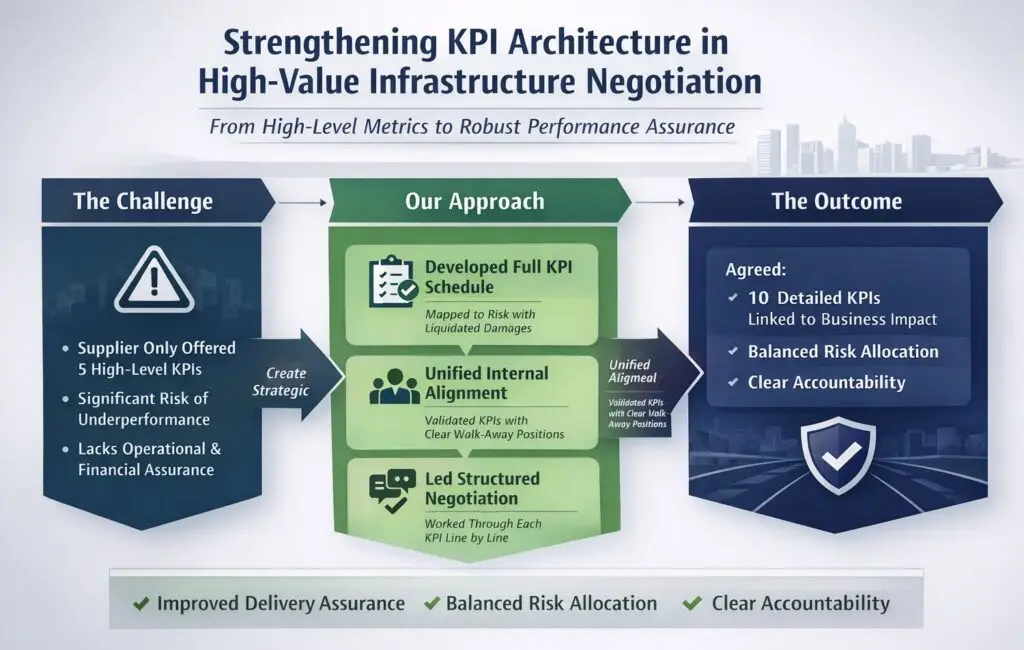
Several rounds of negotiation had already taken place, led by an external consultant. Despite considerable time invested, the supplier was only prepared to accept five very high-level key performance indicators. These measures were generic, loosely drafted and insufficiently connected to operational risk or business impact.
For an estate of strategic importance, this created significant exposure. If delivery faltered, the contractual levers available to protect the organisation would have been limited, slow and commercially weak.
The risk was not abstract. It was operational disruption, financial leakage and reputational impact across a critical national programme.
Reframing the Negotiation Around Risk
Rather than continuing to debate isolated clauses, we stepped back and reframed the negotiation around a fundamental principle: performance measures must reflect risk.
We began by developing a comprehensive KPI schedule that mapped directly to:
- Operational delivery risk
- Installation timelines and dependencies
- Health and safety obligations
- Financial exposure from delay or underperformance
- Business continuity across the estate
This was not an academic exercise. For each KPI, we modelled potential business impact and calculated proportionate liquidated damages or service credits that reflected the genuine cost of failure.
By quantifying consequence, we transformed what had been a theoretical discussion about metrics into a commercial conversation about shared risk.
Building Internal Alignment Before External Pressure
Before re-entering negotiations, we ensured the organisation was fully aligned.
We worked closely with internal operational leads, technical specialists and commercial colleagues to validate every proposed KPI, confirming that each measure was:
- Measurable and auditable
- Operationally meaningful
- Directly linked to risk
- Legally and commercially defensible
Crucially, we categorised KPIs into essential and desirable measures, and agreed clear walk-away positions. This meant that during negotiation we were not reacting in real time, but executing a pre-agreed strategy.
That preparation created something far more powerful than a list of metrics: it created a unified negotiating stance.
Direct Engagement and Structured Negotiation
We joined the negotiations directly and communicated our position clearly and calmly, explaining that high-level KPIs might offer simplicity, but they did not provide adequate protection for a programme of this scale and complexity.
The conversation shifted when we articulated why risk needed to be shared proportionately and transparently, rather than absorbed unilaterally. We made it clear that performance metrics were not a mechanism for penalisation, but a framework for clarity, predictability and mutual accountability.
Over three detailed negotiation meetings, we worked methodically through each KPI line by line. Where the supplier resisted, we explored alternatives. Where measures felt overly rigid, we discussed proportionality. Where service credits appeared high, we demonstrated the underlying cost exposure they were designed to offset.
The discussion was detailed, technical and at times robust, but it remained anchored in principle: risk should sit where it is best controlled.
The Outcome
By the conclusion of the negotiations, we had agreed:
- Ten detailed, risk-aligned KPIs with defined measurement methodology
- Associated service credits calibrated to business impact
- Eight additional performance indicators to strengthen operational transparency
The final position represented a substantial strengthening of the original proposal and moved the contract from symbolic oversight to structured performance assurance.
This delivered three critical outcomes:
- Improved delivery assurance, because performance expectations were explicit and measurable.
- Balanced risk allocation, ensuring the supplier carried appropriate responsibility for controllable outcomes.
- Clear accountability mechanisms, enabling early intervention rather than post-failure escalation.
For a high-risk, business-critical infrastructure programme, this level of clarity was not optional; it was essential.
The Broader Lesson
KPIs are not administrative detail. They are the architecture of accountability.
When performance measures are too high level, risk becomes invisible. When risk is invisible, it becomes expensive.
By investing time in preparation, internal alignment and principled negotiation, we shifted the conversation from “how few metrics can we agree” to “how clearly can we define shared responsibility”.
In complex, high-value contracts, that distinction defines whether governance is symbolic or substantive.