Structure before escalation. Discipline before drama.
Contract underperformance is not unusual. It ranges from minor KPI slippage to sustained delivery failure. It may carry reputational risk, financial exposure or operational disruption. Sometimes it is visible immediately. More often, it develops gradually.
What separates stabilised contracts from deteriorating ones is not luck. It is structure.
Managing underperformance effectively does not begin when a KPI turns red. It begins at contract mobilisation, long before recovery plans are required.
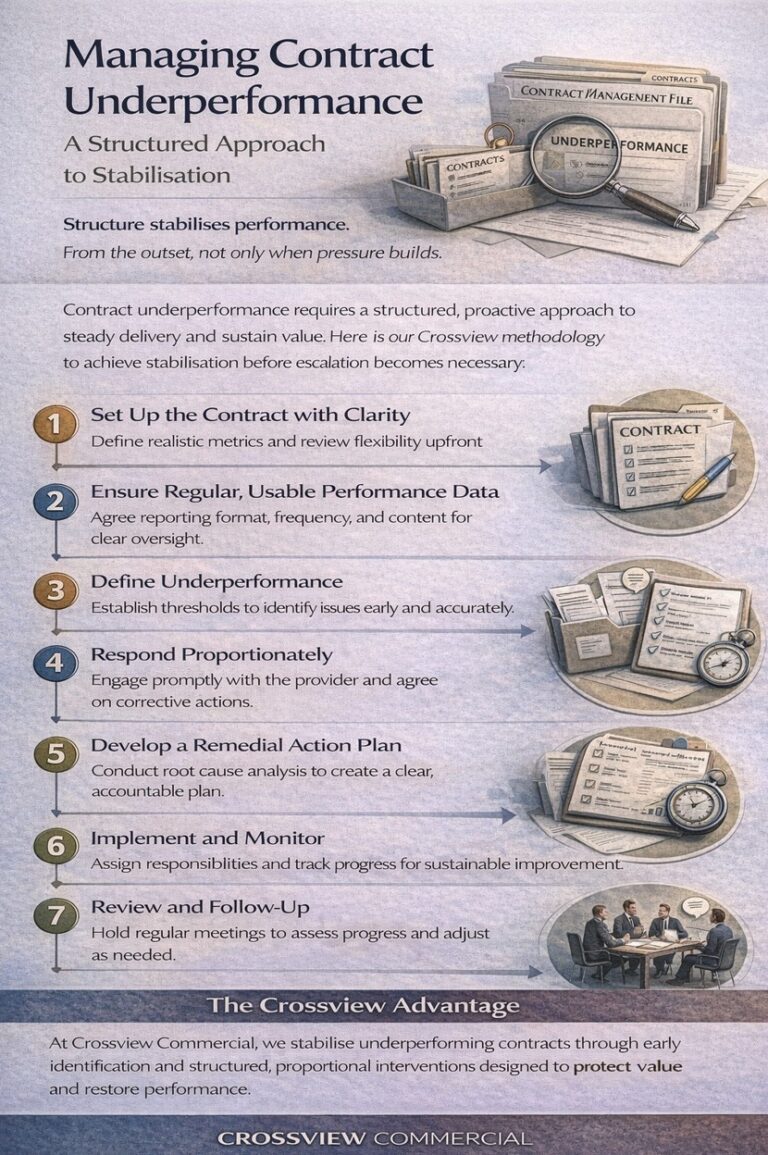
1. Set the Contract Up with Clarity
Underperformance is frequently rooted in ambiguity. If requirements are loosely defined, performance metrics unrealistic or expectations misaligned with resources, recovery becomes unnecessarily complex. The contract must articulate what success looks like in specific, measurable terms.
Clarity also requires flexibility. Particularly in long-term contracts, demand and operating environments shift. Performance frameworks should allow for structured adjustment through review cycles. Rigidity can be as damaging as vagueness.
A well-drafted contract reduces recovery work later.
2. Ensure Regular, Usable Performance Data
You cannot manage what you cannot see. Performance information must be timely, consistent and suitable for analysis. Raw data without context is of limited value. Equally, narrative updates without metrics provide little assurance.
Agree in advance the format, frequency and content of reporting. Define what constitutes acceptable evidence. Establish trend analysis rather than relying solely on point-in-time figures. Usable data transforms oversight from reactive commentary to informed intervention.
3. Identify Underperformance Early
Effective contract management requires clear thresholds. Define what constitutes a red flag. Set tolerance levels for variance. Track trends over time rather than waiting for failure.
Benchmarking can also provide valuable context. Comparing performance against previous periods or similar providers highlights emerging concerns that may not be obvious in isolation.
Early identification allows proportionate response. Delay converts manageable issues into structural risk.
4. Respond Proportionately and Promptly
When underperformance is identified, the response must be deliberate.
Begin by reviewing the contract. Escalation clauses, performance notices, improvement mechanisms and penalty provisions exist for a reason. They provide the framework for action.
Engage the provider early. Conversations should be evidence-based and focused on resolution rather than accusation. Agree corrective actions clearly and document them formally.
Documentation is not administrative detail. It protects accountability. It preserves clarity. It ensures that, if further escalation becomes necessary, the evidential trail is robust. Measured firmness is more effective than sudden severity.
5. Develop a Structured Remedial Action Plan
If performance does not recover through routine intervention, a formal remedial action plan becomes necessary.
This plan should include:
- A clear purpose and defined objectives
- A documented root cause analysis
- A current situation assessment grounded in data
- A time-bound implementation plan with named owners
- An evaluation framework to test sustainability
Without root cause analysis, remedial plans address symptoms. With it, they address systems.
Collaboration at this stage is essential. Providers contribute operational insight. Contract managers contribute oversight and alignment to organisational priorities. The aim is not to apportion blame but to rebalance delivery.
6. Implement and Monitor with Defined Roles
Clarity of responsibility determines whether recovery succeeds.
The provider implements agreed actions and reports progress.
The Service Lead oversees operational alignment and supports delivery adjustments. The Contract Manager monitors compliance with the plan, tests evidence and ensures stakeholders remain informed.
Recovery is rarely instantaneous. Structured monitoring prevents drift and maintains momentum.
7. Review and Close the Loop
Regular review meetings should assess whether performance is genuinely improving or merely stabilising temporarily.
Once the plan concludes, conduct a formal evaluation. Have KPIs returned sustainably to expected levels? Has the underlying cause been addressed? Are governance mechanisms sufficiently robust to prevent recurrence?
If performance does not improve, further contractual remedies — including financial penalties or termination provisions — may need consideration. Escalation should be the result of structured progression, not frustration.
The Wider Impact
A disciplined approach to underperformance benefits both parties.
For providers, clarity of expectations and structured support reduce ambiguity and encourage sustainable improvement. For commissioning organisations, early intervention protects service continuity, reputation and public value.
Underperformance does not automatically signal failure. Handled correctly, it can strengthen governance, clarify expectations and mature the relationship. But that outcome depends on structure.
Because in contract management, recovery is not achieved through reaction.
It is achieved through deliberate, evidence-led control.
The Crossview Perspective
At Crossview Commercial, we treat contract underperformance as a structural issue, not simply a performance incident.
Too often, organisations respond only once pressure builds – when stakeholders are frustrated and options feel limited. Our approach is different. We focus on designing contracts, governance and monitoring frameworks in a way that prevents avoidable deterioration in the first place.
Where performance does slip, we apply a structured stabilisation model:
- Early identification through clear thresholds and usable data
- Formal root cause analysis before remedial planning
- Defined accountability across provider, service lead and contract management roles
- Time-bound improvement plans grounded in evidence
- Governance resets to ensure sustainability
We are deliberate about sequencing. Diagnosis precedes escalation. Structure precedes sanction.
Because in most cases, underperformance is not about unwillingness. It is about misalignment – of expectations, capacity, incentives or process. Our role is to restore that alignment quickly and proportionately, protecting service continuity while preserving commercial credibility.
Strong contract management is not measured by how often escalation is used. It is measured by how rarely it becomes necessary.