There is a persistent myth in commercial life that contracts are about paperwork.
They are not.
They are about power, pressure, perception and people.
The paperwork merely records the rules of the game.
You can draft a flawless specification. You can construct immaculate governance slides. You can quote clause numbers with forensic precision. Yet if you cannot read a room, you will struggle to shift behaviour.
Contract management – real contract management – happens in the invisible space between what is written and what is understood.
It is a psychological game.
The room tells you everything, if you know how to listen.
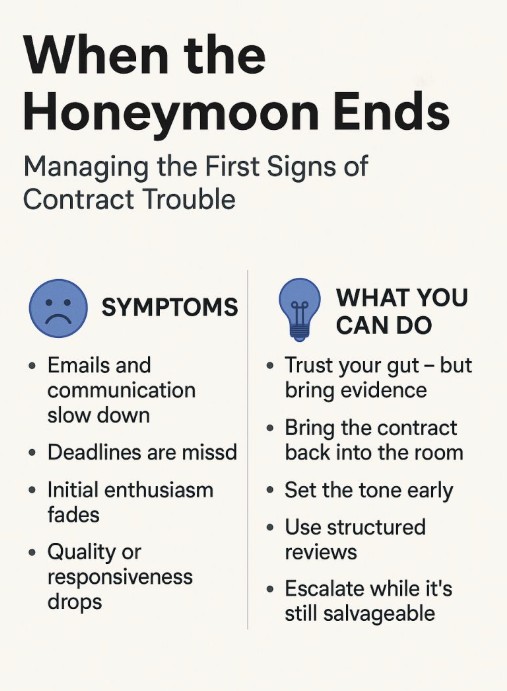
A supplier assures you that performance is “on track”. The words are polished. The tone is not. There is a pause before the answer. A slight redirection towards future innovation. An overemphasis on context. Something is being protected.
You could respond with a clause. Or you could respond with insight.
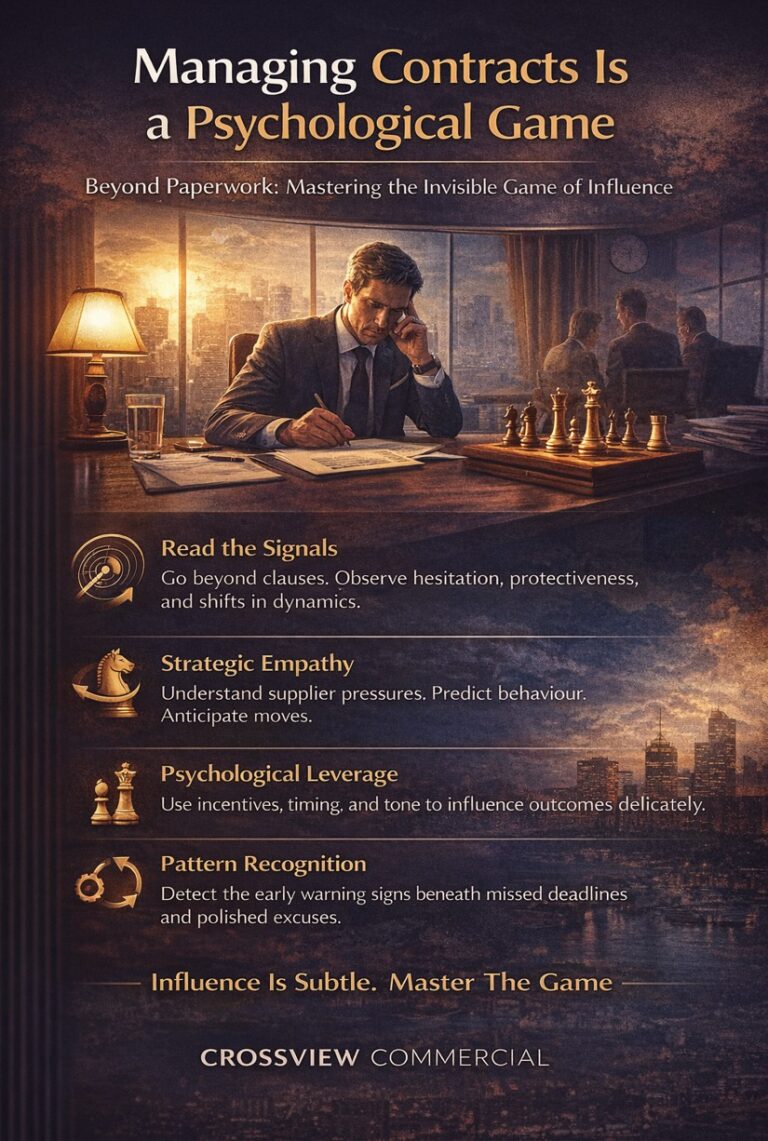
The best contract managers possess a form of radar. Emotional intelligence, certainly – but sharpened into something more tactical. They sense when a deadline miss is administrative and when it signals structural fragility. They notice when confidence is rehearsed rather than earned.
They understand that a missed KPI is rarely just a missed KPI. It is often the visible symptom of something beneath the surface: staffing churn, margin compression, leadership fatigue, a looming re-bid.
And once you see the underlying pattern, you stop playing whack-a-mole with performance metrics and start addressing causes.
Strategic empathy sits at the heart of this.
Not sympathy. Not indulgence.
Empathy as leverage.
To manage a contract well, you must understand what drives the other side. What pressures are shaping their decisions? What risks are keeping them cautious? What are they afraid of losing – margin, reputation, extension, political goodwill?
When you understand incentives, you understand behaviour.
And when you understand behaviour, you stop reacting and start anticipating.
Negotiation, then, becomes choreography.
The inexperienced contract manager demands everything at once. The seasoned one sequences. They know when to hold pressure and when to apply it. They know that invoking formal remedies too early can erode credibility rather than strengthen it. Authority is not volume. It is timing.
There is elegance in restraint.
Sometimes a carefully offered concession – modest flexibility in reporting, public acknowledgement of improvement, a phased recovery timeline — unlocks cooperation more effectively than a penalty ever could. Influence is rarely brute force. It is calibrated movement.
Authority must be handled carefully.
Too rigid and you create resistance. Too accommodating and you invite erosion. The art lies in projecting confidence without theatrics, firmness without hostility.
When you know the contract and the politics behind it, your tone changes. You do not need to threaten. You simply articulate consequence with quiet certainty.
That steadiness unsettles more effectively than aggression ever will.
Experience adds another layer: pattern recognition.
Over time, cycles become familiar. Budgetary pressure rises near financial year end. Innovation narratives flourish near contract renewal. Recovery plans promise transformation “next quarter”. Language shifts subtly when internal instability creeps in.
Performance decline is rarely dramatic. It is incremental. A slower response here. A vaguer report there. A slightly more defensive tone.
If you are attentive, you see the shift long before the dashboard turns red.
And then there is the internal game – often more complex than the external one.
The executive who asks why termination is not immediate. The colleague who downplays risk. The political commitment already announced to Cabinet. The finance pressure that narrows options.
You are balancing multiple audiences while maintaining a coherent strategy. You are absorbing pressure without transmitting panic. You are translating operational nuance into executive clarity.
None of this appears in the contract.
So what allows someone to play this game well?
Technical skill is necessary but insufficient. Qualifications provide structure. Templates provide scaffolding. Governance provides legitimacy.
But instinct is forged elsewhere.
In meetings that did not go to plan.
In negotiations where timing was misjudged.
In performance crises that required calm when others defaulted to escalation.
You learn that dominance is crude. That aggression is often insecurity in disguise. That influence is quieter and more durable.
To manage contracts well is to remain composed while thinking several moves ahead. To understand incentives without being cynical. To be tactical without becoming transactional.
Because the contract is only the visible architecture.
The real game is played in human behaviour.
And those who master that rarely need to raise their voice.
Crossview Commercial was built on the belief that strong contract management is as much behavioural intelligence as it is technical rigour. We combine commercial structure, strategic clarity and psychological insight to help organisations influence performance, stabilise delivery and regain control when complexity rises. Because in high-stakes services, knowing the contract is expected. Knowing how to play it is what creates results.