At the implementation stage of any contract, one of the first responsibilities of a contract manager is to interrogate the agreement properly. Not skim it. Not assume it makes sense. Interrogate it.
This is where the Contract Management File – the CM File – becomes indispensable.
For us, the CM File is not administrative overhead. It is the operational blueprint. It captures objectives, deliverables, reporting lines, governance structure, risk profile, stakeholders and escalation routes. It translates a legal document into a working instrument. And once built well, it becomes the single source of truth throughout the life of the contract.
Without it, consistency fades. Memory replaces evidence. Interpretation replaces clarity. And that is where drift begins.
Objectives: The Most Obvious Thing We Forget
Contract objectives are the reason the agreement exists.
That sounds painfully obvious.
Yet in practice, objectives are often poorly articulated, vaguely drafted or – surprisingly frequently – missing altogether. The explanation is almost always the same:
“We all know what the objectives are.”
Perhaps at the start.
But contracts outlive meetings. They outlive project teams. They outlive restructures. They certainly outlive the original enthusiasm that surrounded the award decision.
Six months in, a new stakeholder joins. Twelve months in, organisational priorities shift. Two years in, policy changes. Suddenly the “obvious” objective is being interpreted in three different ways across three different meetings.
Clarity that lives only in memory is not clarity. It is assumption.
Why Writing Them Down Matters
Writing objectives down and formally agreeing them with the supplier is not bureaucratic fastidiousness. It is commercial risk management.
It does three critical things.
First, it eliminates ambiguity. Once objectives are articulated clearly, “but we thought you meant…” disappears from the vocabulary. Expectations become measurable rather than implied.
Second, it creates a reference point when performance becomes contested. If outcomes slip or delivery deviates, you can return to the original intent. Without that anchor, conversations become subjective and defensive.
Third, it allows evolution. Objectives should not be static relics from the award stage. Markets change. Demand shifts. Political priorities adjust. If objectives are documented properly, they can be reviewed, refined and, where necessary, formally varied.
Contracts do not fail only because of poor performance. They fail because the purpose of the contract quietly changes without anyone acknowledging it.
The Objectives That Hide in Plain Sight
What is written in the specification is only part of the picture. There are always additional layers of intent.
Organisational objectives may sit behind the formal wording: supplier diversity ambitions, environmental impact targets, innovation expectations, local economic development, social value commitments. These may not appear explicitly in every schedule, yet they are central to the strategic rationale for the contract.
If they are not surfaced and discussed, they will not be delivered.
Equally important are supplier objectives.
Why did they enter the agreement? Revenue is the obvious answer. But rarely the full one. Are they seeking credibility in a new sector? Market expansion? Case study exposure? Long-term positioning for larger contracts? Entry into a geographic footprint they previously lacked?
Understanding supplier motivation is not curiosity. It is leverage.
When you know what the supplier values beyond the invoice, you understand how to structure discussions, incentives and performance conversations more intelligently.
The Annual Reset
Objectives should not be filed away after mobilisation.
At least once a year – typically as part of the annual review – there should be a structured reset conversation.
Do the original objectives still reflect organisational priorities?
Have implicit objectives become more important than explicit ones?
Are supplier motivations changing as the contract matures?
Does the agreement still represent strategic value?
This review is not ceremonial. It is preventative.
Because when objectives drift without acknowledgement, contracts gradually become misaligned with the organisation they are supposed to serve.
And misalignment is expensive.
The Bottom Line
Contract managers are not there merely to monitor KPIs. They are there to protect purpose. To ensure that delivery aligns with intent. That resources align with outcomes. That performance aligns with value.
If you do not know why the contract exists – in precise, documented terms — you are managing activity, not impact.
Objectives are not introductory paragraphs. They are the compass.
Lose sight of them, and even a technically compliant contract can quietly fail.
The Crossview Commercial Approach
At Crossview Commercial, we treat contract objectives as the foundation of effective contract management – not a formality at the front of the document.
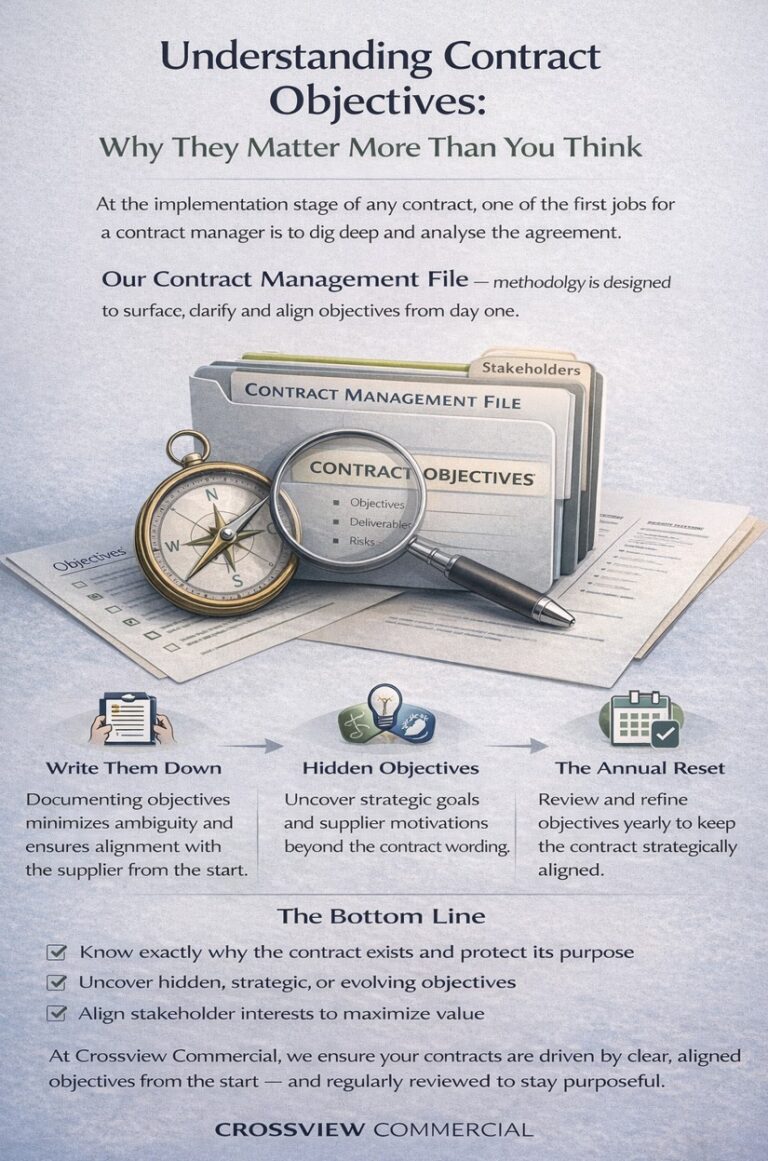
Our Contract Management File methodology is designed to surface, clarify and align objectives from day one. We document not only what is written in the agreement, but what sits behind it: the strategic intent, the organisational drivers and the supplier’s motivations. Because when purpose is explicit, performance becomes measurable.
We also build structured annual objective reviews into governance cycles. Not as an administrative exercise, but as a strategic checkpoint. Are we still solving the problem this contract was designed to address? Are expectations still aligned with funding, demand and capacity? Does the supplier’s incentive remain consistent with ours?
Clarity of objectives prevents drift.
Alignment of objectives prevents underperformance.
And disciplined review prevents slow decline.
Strong contract management is not simply about monitoring delivery.
It is about protecting purpose – and ensuring that every agreement continues to earn its place.
If you would like to review whether your current contracts still reflect your organisation’s true objectives, we offer a structured objective alignment diagnostic as part of our Crossview methodology.
Because knowing what you are trying to achieve is not basic.
It is strategic.