Every contract begins well.
Mobilisation is energetic. Senior people are present. Governance looks robust. Both sides are attentive, responsive and keen to demonstrate credibility. The early months are characterised by goodwill and momentum.
Then the tone shifts.
It is rarely dramatic. Responses slow slightly. Deadlines move “by a few days”. Deliverables technically meet the brief but lack precision. The senior mobilisation team steps back and day-to-day delivery feels less confident. Nothing has failed, but something feels looser than it should.
This is the moment that determines whether a contract stabilises into disciplined performance – or begins a gradual decline.
Most organisations mismanage this stage for one simple reason: the signs are small enough to rationalise. Internal conversations tend to minimise them. It is early days. They are still embedding. We do not want to strain the relationship. The desire to preserve goodwill overrides commercial discipline.
That hesitation is costly.
Early slippage is rarely random. It signals one of three things: unrealistic assumptions at bid stage, emerging resourcing pressure or a behavioural shift once scrutiny reduces. If not addressed early, variance becomes normalised. Once underperformance becomes routine, recovery becomes slower, more political and more expensive.
So what should you do when the honeymoon ends?
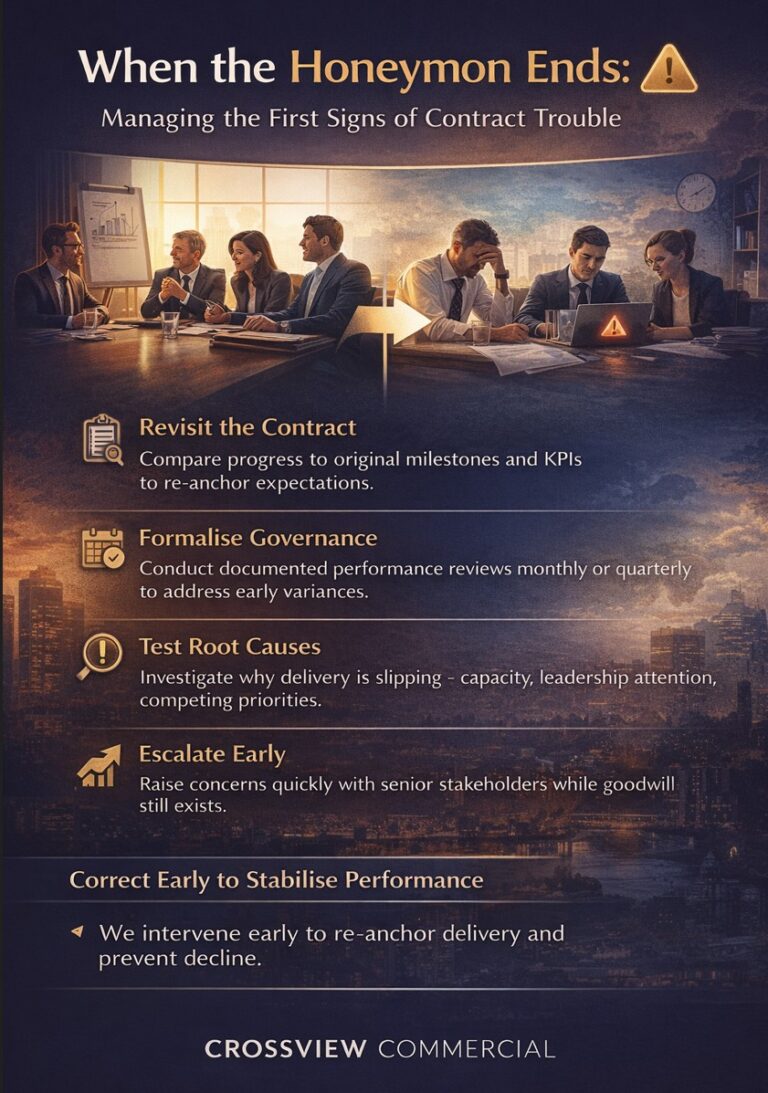
First, re-anchor the relationship in the contract. Do not allow informal ways of working to replace agreed standards. Revisit the mobilisation plan, the delivery milestones and the KPIs. Compare what was promised with what is being delivered. This is not about confrontation; it is about clarity. The contract exists to provide structure precisely when goodwill alone is insufficient.
Second, formalise governance quickly. If structured performance reviews are not yet embedded monthly or quarterly, implement them immediately. Issues should be minuted, actions defined and follow-up tracked. Documentation protects both parties and prevents drift disguised as flexibility.
Third, test root causes early. Ask directly whether capacity, leadership attention or competing priorities are affecting delivery. Do not assume. Evidence the variance and require a recovery plan with timelines and named owners. A well-timed, proportionate conversation at this stage often prevents escalation later.
Fourth, escalate while goodwill still exists. If the delivery team appears stretched or unsupported, raise visibility with the appropriate senior contact. Early escalation is corrective, not punitive. Late escalation is adversarial. The difference lies in timing.
Finally, set tone deliberately. You are not being difficult by holding standards. You are protecting the integrity of the contract and the credibility of your organisation. Clear expectations, consistent governance and documented accountability create stability. Most capable suppliers respond positively to structure. What erodes relationships is ambiguity, not firmness.
Contracts do not usually collapse overnight. They loosen gradually. By the time performance is formally rated red, the behavioural shift has often been embedded for months.
The end of the honeymoon is therefore not a crisis. It is a leadership moment.
How Crossview Commercial Supports This
At Crossview Commercial, we help organisations intervene at precisely this stage – before underperformance becomes entrenched.
Our approach includes:
- Independent mobilisation and early-stage delivery diagnostics
- Structured performance reset frameworks
- Governance redesign and review cadence implementation
- Evidence-based root cause analysis
- Senior-level escalation strategy and briefing
- KPI and expectation realignment where necessary
We work to stabilise contracts early, restore structure and prevent avoidable recovery programmes.
Because the most cost-effective intervention is not a performance notice at month twelve.
It is disciplined leadership at month three.